
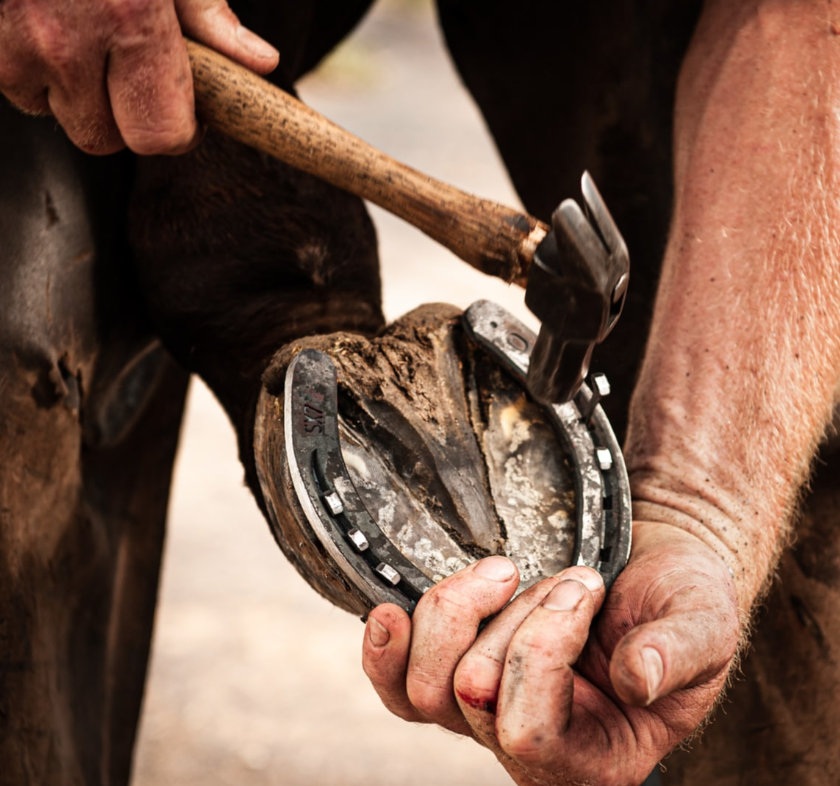
A farrier is a specialist in equine hoof care, including the trimming and balancing of horses’ hooves and the placing of shoes on their hooves, if necessary. A farrier combines some blacksmith‘s skills (fabricating, adapting, and adjusting metal shoes) with some veterinarian‘s skills (knowledge of the anatomy and physiology of the lower limb) to care for horses’ feet.
While the practice of putting protective hoof coverings on horses dates back to the first century,[1] evidence suggests that the practice of nailing iron shoes into a horse’s hoof is a much later invention. One of the first archaeological discoveries of an iron horseshoe was found in the tomb of Merovingian king Childeric I, who reigned from 458-481/82. The discovery was made by Adrien Quinquin in 1653, and the findings were written about by Jean-Jacques Chifflet in 1655. Chifflet wrote that the iron horseshoe was so rusted that it fell apart as he attempted to clean it. He did, however, make an illustration of the shoe and noted that it had four holes on each side for nails.[2] Although this discovery places the existence of iron horseshoes during the later half of the 5th century, their further usage is not recorded until closer to the end of the millennia. Carolingian Capitularies, legal acts composed and published by Frankish kings until the 9th Century, display a high degree of attention to detail when it came to military matters, even going as far as to specify which weapons and equipment soldiers were to bring when called upon for war.[3] With each Capitulary that calls for horsemen, no mention of horseshoes can be found. Excavations from Viking-age burials also demonstrate a lack of iron horseshoes, even though many of the stirrups and other horse tack survived. A burial dig in Slovenia discovered iron bits, stirrups, and saddle parts but no horseshoes.[4] The first literary mention of nailed horseshoes is found within Ekkehard’s Waltharius,[3] written c. 920 AD. The practice of shoeing horses in Europe likely originated in Western Europe, where they had more need due to the way the climate affected horses’ hooves, before spreading eastward and northward by 1000 AD.
The task of shoeing horses was originally performed by blacksmiths, owing to the origin of the word found within the Latin ferrum. However, by the time of Edward III of England (r. 1327-1377) the position, among others, had become much more specialized. This was part of a larger trend in specialization and the division of labour in England at the time.[5] In 1350, Edward released an ordinance concerning pay and wages within the city of London. In the ordinance it mentioned farriers and decreed that they were not to charge more for their services than “they were wont to take before the time of the pestilence.”[6] The pestilence mentioned was the Black Death, which places the existence of farriers as a trade independent of blacksmiths at the latest in 1346. In 1350, a statute from Edward designated the shoer of horses at court to be the ferrour des chivaux (literally Shoer of Horses), who would be sworn in before judges. The ferrour des chivaux would swear to do his craft properly and to limit himself solely to it.[7] The increasing division of labour in England, especially in regards to the farriers, proved beneficial for Edward III during the first phase of the Hundred Years’ War. The English army traveled into France with an immense baggage train that possessed its own forges in order for the Sergeants-Farrier and his assistants to shoe horses in the field. The increased specialization of the 14th Century allowed Edward to create a self-sufficient army, thus contributing to his military success in France.
Why Do Horses Need Horseshoes?
If you have ever watched horse races or seen the horses being trained in riding halls, you will know the trotting noise which comes from the horseshoes. Horseshoes are made from metal and will be nailed into the horses’ hooves. So, why do horses need to wear horseshoes? Are horseshoes painful? Does it hurt horses to put shoes on them?